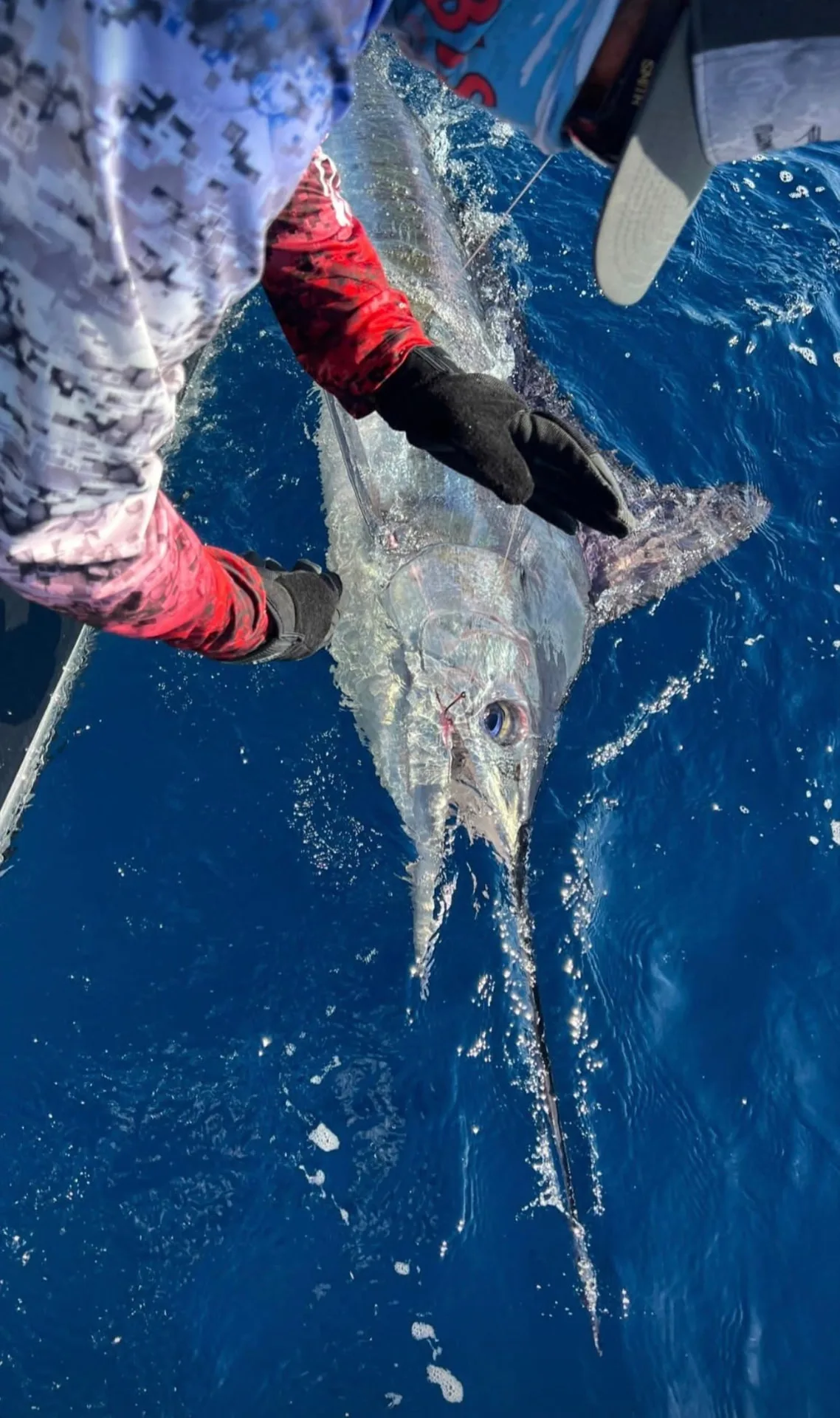
The leader comes free, the hook is out, and for a moment the striped marlin just hangs beside the hull, lit up in electric blue. Then it kicks once and disappears into the deep water off the Baja coast. Anyone who has fished Cabo or Mag Bay has watched some version of that scene. The question that follows is just as familiar: where does that fish go next?
For most of the history of this fishery, the honest answer was “we don’t really know.” A handful of long-running research projects off Baja California Sur are starting to fill in that blank. They don’t give a full map of every marlin’s life, but they tell us a lot more than we knew a generation ago.
Following the tagged fish
The longest look comes from a study led by Chi Hin Lam and published in Animal Biotelemetry in 2022 (Lam et al., 2022). In November of 2008–2010, researchers caught 99 striped marlin off Magdalena Bay on rod and reel with live bait and circle hooks and surgically implanted archival tags, small data loggers that record depth and temperature. Ten tags came back after the fish were later caught, and the researchers were able to download data from nine of them.
Because striped marlin follow a fairly regular daily pattern of swimming depths, the team used those dive records to estimate where each fish was, a method called depth-based geolocation. The longest reconstructed record covered 7.7 years.
The estimated tracks stayed in the Eastern Pacific. In winter, from November through February, the tagged fish concentrated off the southern tip of Baja California on both the Pacific side and in the Sea of Cortez. In spring, their core areas spread offshore, including around the Revillagigedo Islands. Some fish used waters west of the Galápagos, and one fish crossed the equator. It was the first trans-equatorial movement documented for striped marlin in this region. By September the tracks pointed back toward Baja and the Magdalena area.
Keep two caveats in mind. These are estimated positions from depth data, not GPS tracks, and they come from nine fish. They show what a small group of fish did. They don’t prove a single migration route that every striped marlin follows.
What the fish find off Cabo
Why would a marlin return to the tip of the peninsula? Food is part of the answer. A 2026 study in the Journal of Fish Biology, led by Pamela Pacheco-Aldana with coauthors including Sofía Ortega-García, examined striped marlin caught off Cabo San Lucas (Pacheco-Aldana et al., 2026). Between 2019 and 2022 the team analyzed 251 stomachs with identifiable prey and 80 muscle samples.
The diet was dominated by open-water fishes and cephalopods. The most important prey included jumbo squid, paper nautilus, Pacific mackerel and finescale triggerfish, and the stomach contents changed with the seasons.
The two methods measure different time spans. A stomach is a snapshot of the last few meals. Muscle chemistry (stable isotopes) builds up over weeks to months, so it shows what the fish has been eating over a longer stretch. We plan to come back to this research in more depth.
What tags can reveal after release
Tags can also answer a question that matters to every crew practicing catch and release: does the fish survive? In the autumns of 2000 and 2001, Michael Domeier, Heidi Dewar and Nicole Nasby-Lucas fished off Magdalena Bay with typical recreational tackle and live bait. They put pop-up satellite tags on striped marlin. The tags recorded depth and temperature, so the researchers could tell whether a fish had died (Domeier et al., 2003).
Of the 61 fish whose outcomes could be determined, 16 died, all within five days of release. Injury was the clearest warning sign. Every fish bleeding from the gill area died, as did 63% of deep-hooked fish. Among fish released in good condition, 9% died. The first year also compared hook types. Circle hooks landed marlin just as well as J-hooks and were far less likely to cause serious bleeding or lodge anywhere other than the mouth.
Those numbers describe live-bait fishing off Mag Bay more than two decades ago. They aren’t a survival rate for today’s Cabo charter fleet, which would need current local tagging data. The practical lessons still hold: use circle hooks, keep handling short and avoid deep hooking.
The fish we let go
Taken together, the research suggests that the striped marlin swimming away from a boat off Cabo may stay in the Eastern Pacific for years. It may head offshore toward the Revillagigedos and return to the tip of Baja, where it finds squid and mackerel. Each careful release gives it a better chance of making that trip. For more, read our guide to striped and blue marlin in Cabo and the latest Baja fishing report.
What have you noticed about striped marlin off Cabo or Mag Bay that you’d like a marine scientist to explain? Send us your question for the Cabo Sportfishing Magazine podcast at cabosportfishingmagazine@gmail.com.
Sources
- Lam CH et al. (2022). Depth-based geolocation processing of multi-year striped marlin archival tag data. Animal Biotelemetry.
- Pacheco-Aldana P et al. (2026). Seasonal, sex and ontogenetic trophic shifts of striped marlin in Cabo San Lucas. Journal of Fish Biology.
- Domeier ML, Dewar H, Nasby-Lucas N (2003). Mortality rate of striped marlin caught with recreational tackle. Marine and Freshwater Research 54: 435–445.
- NOAA Fisheries — Striped marlin
- ISC26 — Pacific blue marlin stock assessment