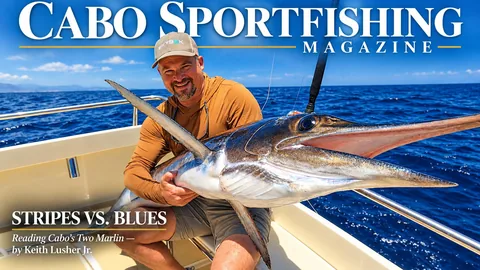
Keith Lusher Jr. is an award-winning outdoor writer, web designer, photographer and radio host based in Covington, Louisiana, who calls Cabo his second home. He has written for Cabo Sportfishing Magazine before, including First Time Fishing Cabo: What Every Angler Should Know and You Hook It, We Cook It: Inside Cabo's Catch & Cook Tradition.
The first striped marlin I ever caught hit a lure so far back in the spread that I couldn't believe it was my line in its mouth. As the crew handed me the rod and I sat in the fight chair, it launched out of the water again. I had never seen anything like it.
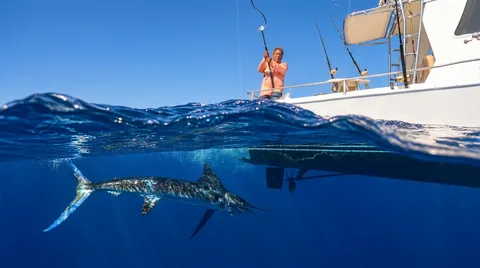
That trip, aboard a Tag Cabo Sportfishing boat with Arturo Chacón, produced not one striped marlin but two. Both were right around 150 pounds, but they could not have fought more differently. The first fish spent most of a 20-minute fight in the air. The second ate, turned and went straight down.
"Sometimes they do that," Chacón said. "They'll hit the lure and head down deep."
For a while, nobody on the boat was sure what we had. When the fish refused to come up, the crew started hollering that it might be a blue, and my heart rate went with them. It turned out to be another striper, but that moment stuck with me. Anglers talk about these two fish in the same breath, yet once you know what separates them, you fish for them very differently.
Two fish, two weight classes
Striped marlin are the smaller of the two. Most Cabo stripers fall somewhere between 100 and 200 pounds, and the all-tackle world record for the species is 494 pounds, which tells you how rarely they get truly huge.
Blue marlin live in a different weight class. "Cabo produces blues in the 300 to 500-pound range, and the Pacific blue marlin record sits above 1,300 pounds," Chacón said. "When a blue eats, the crew reaches for heavier tackle and the angler settles in for a much longer day."
Season: why October is special
Striped marlin prefer cooler water than blues, which is why they're Cabo's year-round billfish and why winter is often their best stretch.
The fishing reports I've received over the years show that pattern. One January, when water temperatures dropped from 85 to 69 degrees, the stripers didn't leave; they moved. "When the water was warmer, we experienced fantastic fishing just 5 to 15 miles offshore, targeting an abundance of wahoo and striped marlin," one report said. Once it cooled, crews ran 20 to 30 miles out "to locate favorable water breaks and good chlorophyll concentrations," and still found striped marlin there.
Blue marlin follow the warm water. Their prime window in Cabo runs through summer and into fall, which is why the big October tournaments are built around blue and black marlin. That overlap is what makes fall so interesting. In October, an angler leaving Cabo's marina can realistically raise either fish on the same day.
Where you find them
Striped marlin are surface fish. They're often spotted before they're hooked, tailing, sunning or working a bait ball near the top. That's what makes Cabo's sight-casting fishery possible.
Blues are usually raised blind. Cabo fleet reports consistently note blue marlin coming from farther offshore, while stripers and sailfish hold closer to the beach. Most of the time, you won't see a blue until it's already in the spread.
What they eat
The bait plan tells you which fish the crew is really hunting.
For striped marlin, live bait rules. "Live bait such as caballito and mackerel are excellent choices for marlin and tuna," one November report noted. That same month, the stripers were "hitting live bait, lures, and teasers hard."
Stripers can be taken at slower trolling speeds than blues, and they tend to slash at prey with the bill rather than simply inhaling it. That's why so many striper bites look tentative. The fish lights up, follows, swats, and may need a bait switched in before it commits. Even on good days, the stripers can be "a bit picky mid-day."
Blue marlin are lure fish. Crews troll larger skirted lures at higher speeds, because "blues often ignore slow-trolled live bait that stripers and sailfish will eat," Chacón said.
How they strike
A striped marlin bite is often a visual event: a bill and a lit-up purple body behind the bait, a few swipes, then the commitment.
A blue marlin bite is more like a car wreck. The fish comes from below at speed and hits hard, often with little warning. There's rarely time to drop back or switch baits. The rod just goes down.
How they fight
Striped marlin are the acrobats, and my first fish lived up to the reputation with jump after jump. But my second striper proved they can also dig in. Reeling that fish felt like trying to drag a truck up from the bottom. The fight lasted about 35 minutes, and just when I finally had it at the boat, it made another run that wiped out nearly everything I'd gained in the previous 10 minutes. I still can't get over the horsepower in a 150-pound fish.
The crew coached me through both fights. "Horse the fish with the rod, then reel as the tip comes down," I was told. Letting the reel do the work only lengthens the fight.
I'll pass along one more lesson I learned the hard way: wear gloves. I didn't that day, and by the second fish I'd worn the skin off part of my right hand. A 35-minute fight is long enough to make that hurt. A blue marlin fight can last hours.
That's the real difference with blues. They fight with weight. The first run can be long and fast enough to strip a reel in a hurry, and the rest is often a deep, grinding pull that can go on for hours with a big fish.
Telling them apart
If you're not sure what's on the end of your line, a few clues help. Striped marlin have a flatter, more compressed body, a tall pointed dorsal fin and a narrow lower jaw. Their stripes stay vivid even after the fight, while the stripes on a blue fade quickly once the fish is stressed. Blues are rounder and heavier through the shoulders, with a broad, short lower jaw.
Which one should you target?
Catching those two stripers was amazing, so I'm not going to tell anyone to pass on striped marlin. They're here year-round, they jump, and they'll test you.
But if the timing is right and the opportunity presents itself, go for the blue. They're harder to catch, and that's exactly what makes them worth chasing.
I've watched other anglers bring blue marlin to the boat in Cabo, but I've never had one on my own line. The next time I'm on the water in Cabo, a blue marlin is going to be my first request.