By Arturo Chacón
Cabo Sportfishing Magazine
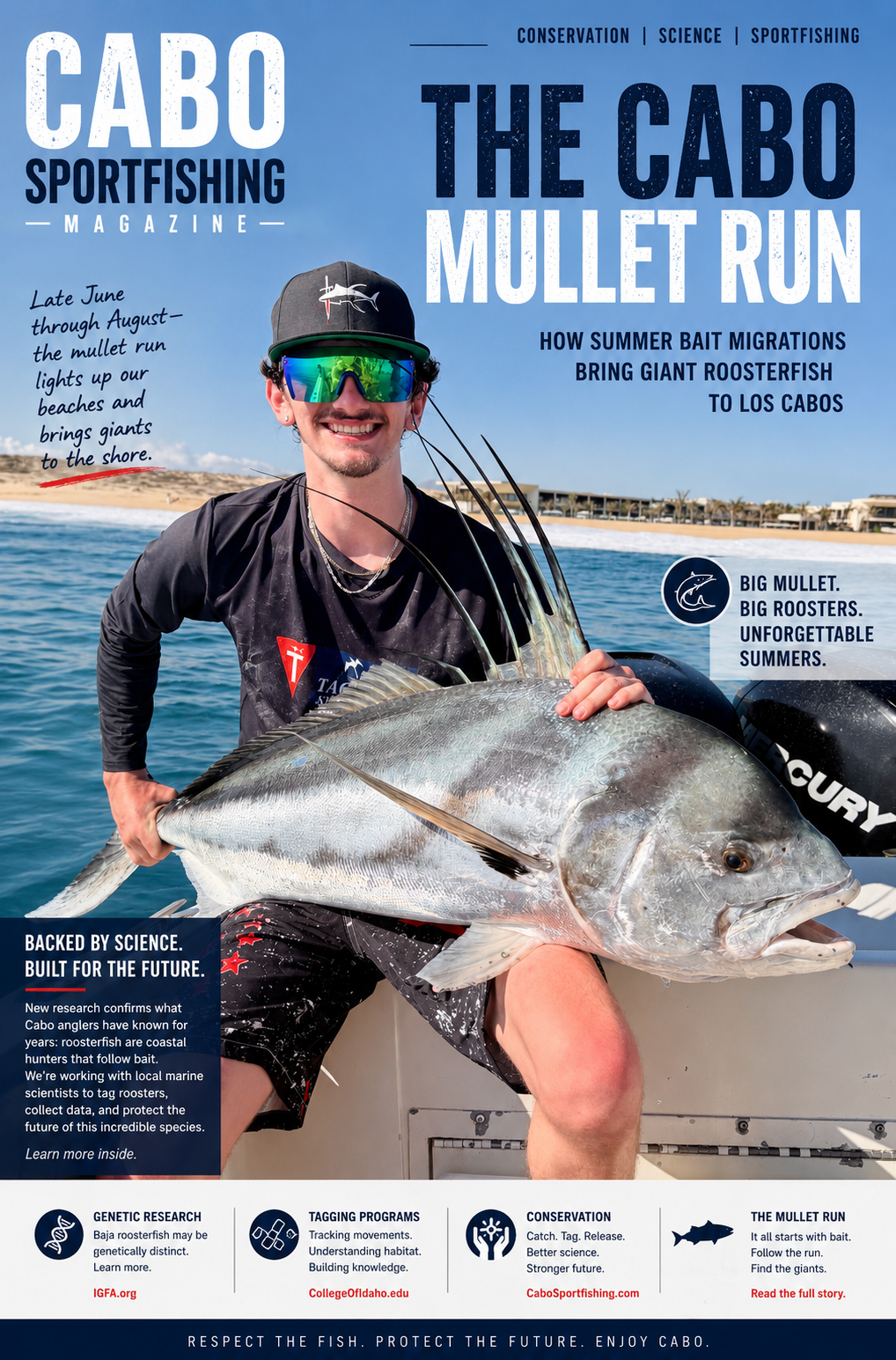
Every year, from late June through August, one of the most exciting natural events in Baja California Sur begins to unfold along the beaches of Los Cabos.
Large schools of mullet move along the coastline, gathering around sandy beaches, rocky points, and shallow bays. To most beachgoers, these baitfish may go unnoticed. But to experienced anglers, the arrival of the mullet signals something much bigger.
The giant roosterfish are coming.
For generations, local captains, surf fishermen, and pangueros have observed the same pattern. As the mullet schools increase, trophy roosterfish begin appearing along the beaches and nearshore waters of Cabo San Lucas, San José del Cabo, Palmilla, Punta Gorda, and the East Cape.
Today, marine scientists are beginning to confirm what Baja anglers have known for decades: roosterfish are highly specialized coastal predators that spend most of their lives hunting baitfish in shallow nearshore environments. Research using acoustic telemetry has shown roosterfish spend more than 90% of their time within the upper water column and remain remarkably close to shore throughout much of their lives.
Scientific Source:
https://www.scielo.cl/scielo.php?pid=S0718-560X2015000100014&script=sci_arttext
Why Roosterfish Follow the Mullet Run
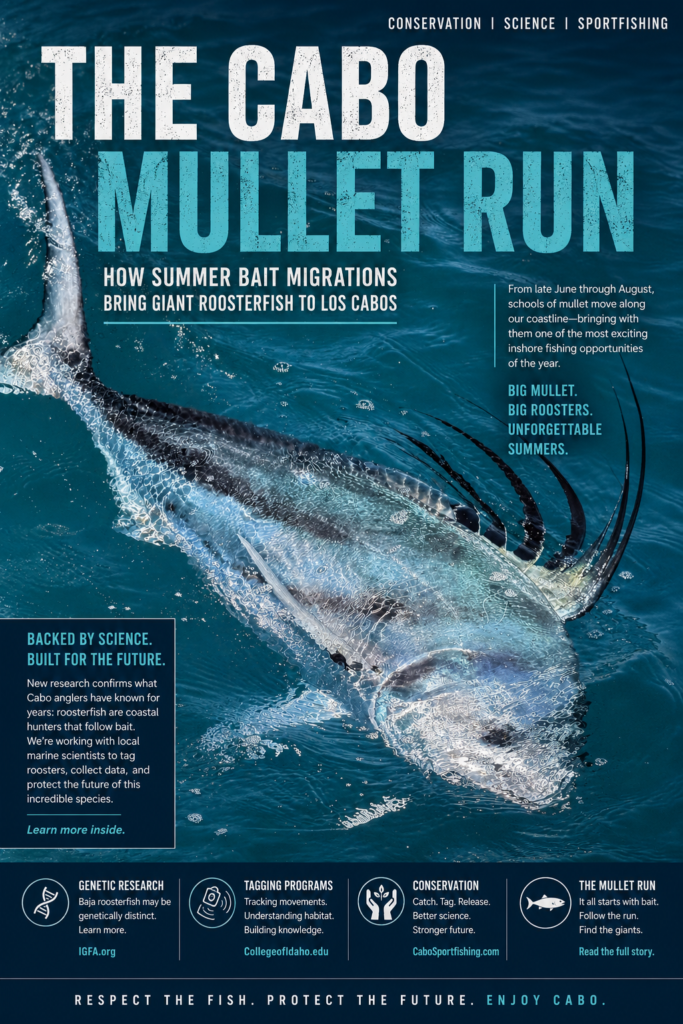
Roosterfish (Nematistius pectoralis) are one of the most unique gamefish found anywhere in the world.
Unlike tuna, marlin, or dorado that roam offshore waters, roosterfish are coastal hunters. They patrol beaches, reefs, points, and bait-rich shorelines searching for prey.
As mullet schools migrate through Los Cabos each summer, they provide an abundant food source for larger roosterfish. Mature roosterfish are known to prey on mullet, sardines, mackerel, and other schooling baitfish that gather along the coastline.
This explains why some of the largest roosterfish of the year are often caught during the summer months when bait concentrations are at their highest.
Many anglers have witnessed giant roosterfish pushing mullet schools onto the beach, creating explosive feeding opportunities that rank among the most exciting experiences in saltwater fishing.
What Science Is Teaching Us About Roosterfish
Although roosterfish are one of the most iconic gamefish in the Eastern Pacific, they remain surprisingly understudied.
Recent research supported by the International Game Fish Association (IGFA) and scientists from Mexico, Costa Rica, Panama, and the United States has revealed something remarkable.
Genetic studies suggest that roosterfish populations in Baja California Sur may be genetically distinct from those found farther south in Central America.
In simple terms, roosterfish from Baja California Sur may represent their own regional population rather than being replenished by fish migrating from thousands of miles away.
If confirmed through additional research, this discovery highlights the importance of protecting roosterfish populations locally.
Learn More:
https://igfa.org/roosterfish-research-program/
Related Research:
https://igfa.org/2025/02/20/the-igfa-and-the-future-of-roosterfish-a-landmark-study/
A New Era of Roosterfish Research in Baja California Sur
At Cabo Sportfishing Magazine, we believe anglers have an important role to play in conservation.
That is why we are currently working to develop the Baja Roosterfish Research Program, a collaborative effort that will bring together local captains, anglers, marine biologists, oceanographers, universities, and conservation organizations.
The goal is simple:
- Tag and release roosterfish throughout Baja California Sur.
- Collect data on seasonal movements.
- Better understand how roosterfish interact with mullet and other baitfish migrations.
- Study habitat preferences.
- Promote responsible catch-and-release fishing.
- Support future conservation efforts through science-based research.
Because roosterfish are a species found only in the Eastern Pacific, every piece of information collected helps scientists better understand one of the most unique predators in the ocean.
New Satellite Tagging Projects Bring Hope
Interest in roosterfish research continues to grow.
In 2026, researchers from the College of Idaho, Woods Hole Oceanographic Institution, and CICIMAR-IPN in La Paz launched a satellite tagging project in Baja California Sur aimed at understanding roosterfish movement patterns and habitat preferences.
Scientists successfully deployed satellite tags that will collect information on depth, temperature, and movement over extended periods.
Read About the Project:
https://collegeofidaho.edu/news/college-of-idaho-research-team-launches-international-study-of-roosterfish-in-baja-mexico-2/
These studies may help answer questions anglers have debated for decades:
- Do roosterfish migrate long distances?
- Do they return to the same beaches every year?
- How closely do they follow bait migrations?
- What habitats are most important for spawning and juvenile development?
Why Conservation Matters
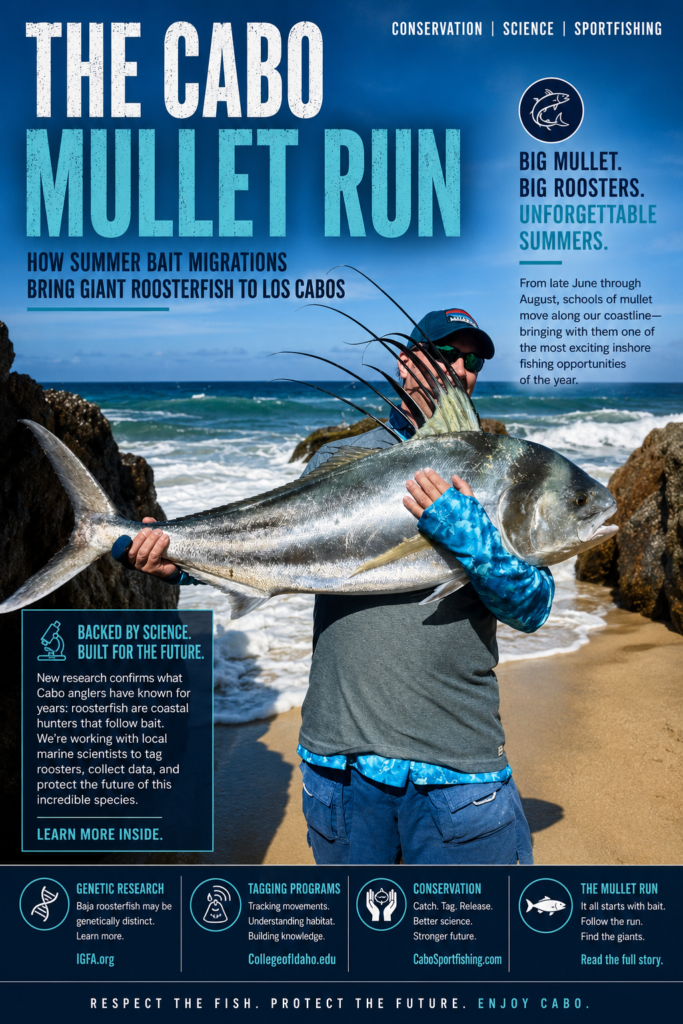
The future of roosterfish fishing depends on healthy coastal ecosystems.
Without healthy baitfish populations, healthy beaches, and clean coastal waters, roosterfish populations cannot thrive.
Unlike many commercial fisheries, roosterfish create tremendous economic value through catch-and-release sportfishing. A single roosterfish can provide unforgettable experiences for countless anglers throughout its lifetime.
As more anglers embrace conservation and participate in scientific research, Baja California Sur has an opportunity to become a global leader in roosterfish management and protection.
The Future of the Cabo Mullet Run
Every summer, the arrival of the mullet reminds us how connected the marine ecosystem truly is.
A simple baitfish migration triggers a chain reaction that attracts predators, supports local economies, fuels tourism, and creates some of the most memorable fishing opportunities found anywhere in the world.
As the 2026 mullet run continues along the beaches of Los Cabos, anglers will once again witness giant roosterfish chasing bait through the surf.
But this time, thanks to growing collaboration between scientists and the fishing community, we have an opportunity to learn more about these incredible fish than ever before.
The next great discovery about roosterfish may not come from a laboratory.
It may come from an angler standing on a Cabo beach, watching a giant roosterfish explode on a school of mullet at sunrise.